TaxesGlobal Mobility
US Expat Taxes in Spain and the UK: 2026 Guide (Return Filed in 2027)
Americans in Spain or the UK still file a US return for 2026. Deadlines, FBAR and Form 8938, FEIE vs foreign tax credit, Modelo 720, the UK SRT and FIG regime, and how to catch up on missed years.
 Aequify Team
Advising clients in this situation? Get a sample client report
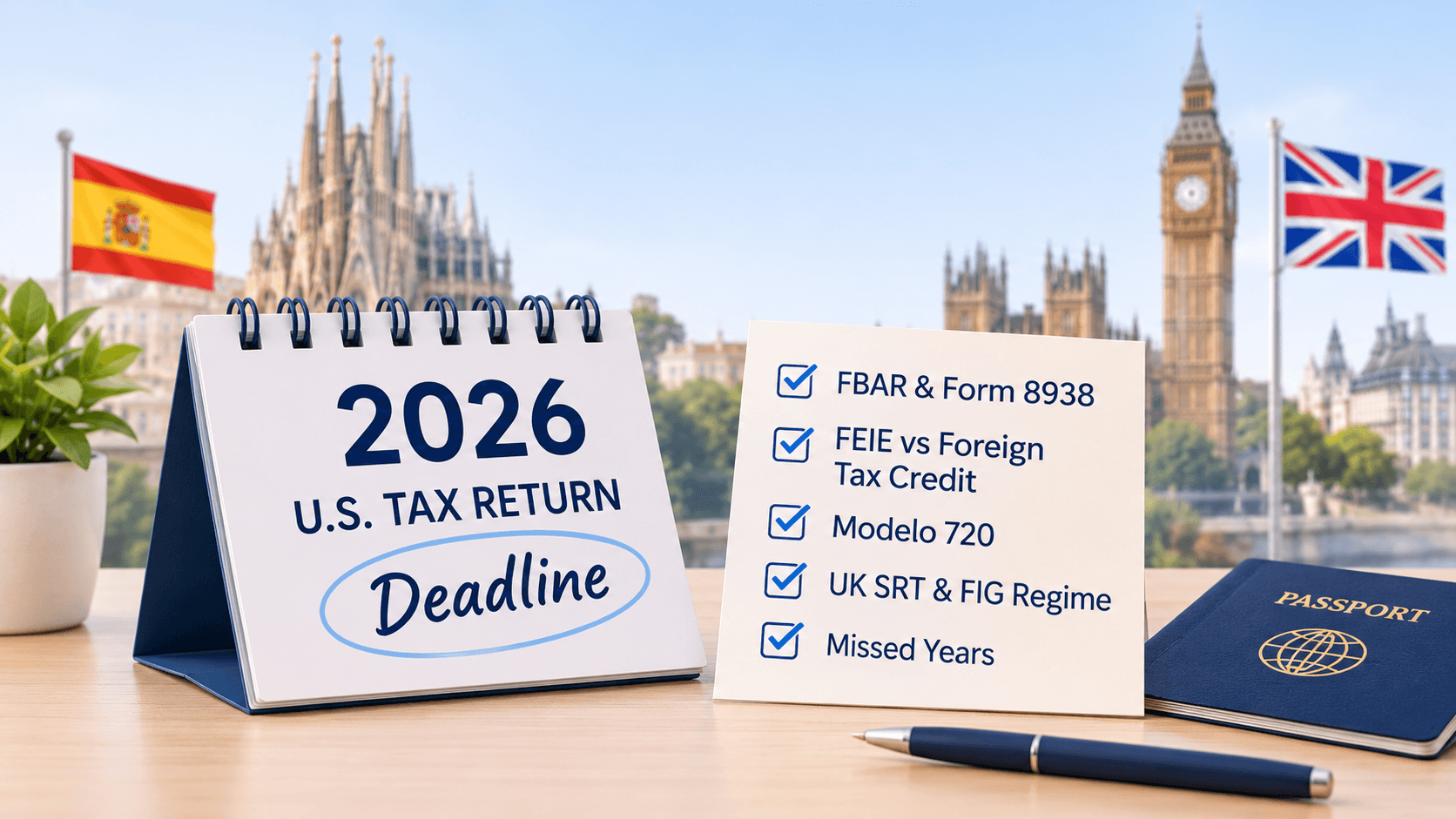
If you are a US citizen or green card holder living in Spain or the UK, you still file a US tax return for 2026 if your income is above the normal filing threshold. The return is due 15 April 2027, with an automatic extension to 15 June 2027 if you live abroad. You may also need an FBAR (foreign accounts over $10,000) and Form 8938. Most people in Spain and the UK end up owing little or no extra US tax because of the foreign tax credit, but the forms are still required.
Filing and paying are two different questions. Most of the trouble Americans abroad get into comes from mixing them up.
This guide covers the 2026 calendar-year US return, filed in 2027. In the UK that matters, because the UK tax year runs 6 April to 5 April. One US return pulls from two UK tax years.
This is general information, not tax or legal advice. Your result depends on your residence, citizenship, income, assets and family. Check your position with a qualified US-Spain or US-UK adviser.
How Aequify helps: Aequify connects your accounts in the US, Spain and the UK in one place, tells you which US, UK and Spanish forms you are likely to need, and turns your data into filing-ready reports for your adviser. Its personalised tax preparation tells you exactly which documents to upload and which questions to answer for your situation, so you are ready well before the deadline. If you don't have an adviser yet, you can find one who specialises in expats through Aequify. Aequify is SOC 2 Type II certified.
What changed for the 2026 tax year
- Higher FEIE. The foreign earned income exclusion rises to $132,900, up from $130,000 for 2025 (IRS Rev. Proc. 2025-32).
- Delinquent FBAR Submission Procedures removed. The IRS took the page down on 1 July 2026. If you only missed FBARs, there is no longer a published penalty-free route for that alone. See the catch-up section below.
- No residence-based taxation. Despite the headlines, the One Big Beautiful Bill Act did not end citizenship-based taxation. You still file.
- UK: second year of the FIG regime. 2026-27 is the second UK tax year under the rules that replaced non-dom status.
The rules at a glance
- Do Americans abroad still file US taxes? Yes, if income is above the filing threshold. Some forms are required even when no tax is due.
- Will I pay tax twice? Usually not. Foreign tax credits, the FEIE and treaties reduce double taxation.
- When is the 2026 return due? 15 April 2027. Automatic extension to 15 June 2027 if you live abroad. Form 4868 extends filing to 15 October 2027.
- Does an extension delay interest? No. Interest runs from 15 April 2027.
- FBAR threshold? Over $10,000 combined across foreign accounts at any point in 2026.
- Is Form 8938 the same as FBAR? No. Different thresholds, different definitions, different filing. Many people file both.
- Missed years of filing? Check whether you qualify for the Streamlined Foreign Offshore Procedures before sending late returns.
Why the US still expects a return
The US taxes its citizens and green card holders on worldwide income, wherever they live. Your US return can include your Spanish or UK salary, freelance income, bank interest, dividends, rent, capital gains, pension payments and income from foreign companies or trusts.
Green card holders stay US tax residents until that status formally ends. Giving up a green card or citizenship has its own tax consequences, so get advice first.
How Aequify helps: Connect your bank, brokerage and pension accounts in each country and Aequify classifies the income for US purposes and converts it to dollars. If you freelance or run a business in Spain or the UK, Aequify sorts your transactions into income and expense categories under US rules and prepares the Schedule C data. It does the same for interest and dividends (Schedule B), capital gains (Schedule D) and rental income (Schedule E).
How double taxation is reduced
Foreign tax credit (Form 1116)
You can usually claim a credit for income tax paid to Spain or the UK. The credit is capped at the US tax on that category of foreign income, so it is not a refund of every euro or pound you paid. Because Spanish and UK rates are often as high as or higher than US rates, the credit wipes out the US bill for many people. Unused credits can usually be carried back one year and forward ten.
Foreign earned income exclusion (Form 2555)
If your tax home is abroad and you pass the bona fide residence test or the physical presence test (330 full days outside the US in 12 months), you can exclude up to $132,900 of earned income for 2026. Each qualifying spouse gets their own exclusion.
It covers wages and self-employment income only. It does not cover pensions, interest, dividends or gains, and it does not remove US self-employment tax.
In Spain and the UK, the FEIE is generally the wrong choice. It can shrink your usable foreign tax credits and affect family credits. You cannot claim a credit on income you have excluded, and if you revoke the election, you generally cannot use it again for five years without IRS approval.
Tax treaties
The US has income tax treaties with Spain and the UK. They help with pensions, employment income and residence conflicts. But the "saving clause" lets the US keep taxing its own citizens as if most of the treaty did not exist. A treaty is not a filing exemption. Some treaty positions must be disclosed on Form 8833.
Key dates for the 2026 US return
- 15 April 2027: Regular filing and payment deadline.
- 15 June 2027: Automatic two-month extension if, on 15 April, you live and have your tax home outside the US and Puerto Rico. Attach a statement saying you qualify. This also extends the time to pay, but interest still runs from 15 April.
- 15 October 2027: Extended deadline if you file Form 4868 (by 15 June if you used the overseas extension). More time to file, not to pay.
- 15 October 2027: FBAR deadline. It is due 15 April but extended automatically. No request needed.
If you moved abroad in 2026 and will not meet the FEIE test by your deadline, Form 2350 can give you more time. Or file without the exclusion and amend later.
How Aequify helps: Aequify shows the US, UK and Spanish deadlines that apply to you in one calendar and reminds you before each one. Personalised tax preparation starts early, so you are uploading documents and answering questions in good time rather than the week before 15 June.
FBAR and Form 8938
FBAR (FinCEN Form 114)
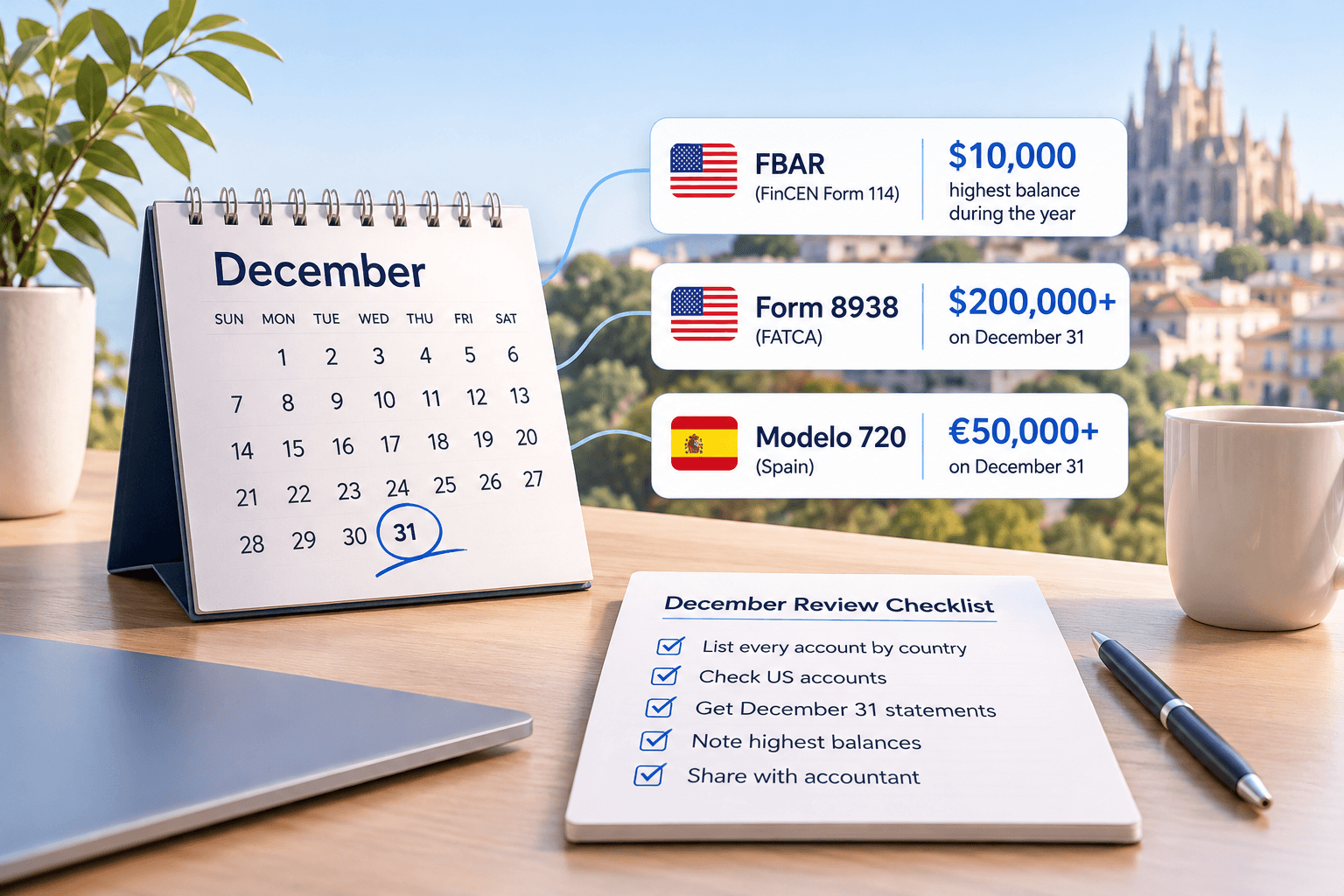
You must file an FBAR if the combined highest balances of all your foreign accounts went over $10,000 at any time in 2026. It is the total across accounts, not per account. A Spanish current account that peaked at €7,000 and a UK savings account that peaked at £4,000 are enough. Accounts with no income count. So do joint accounts and accounts you only have signature authority over.
For each account you need the highest balance in the year, not the year-end balance, converted at the US Treasury's 31 December exchange rate. The FBAR is filed online with FinCEN, not with your tax return.
Form 8938 (FATCA)
Form 8938 goes with your tax return. It covers a wider range of assets than the FBAR, including some interests in foreign entities and financial instruments.
- Single or married filing separately: over $200,000 on 31 December, or over $300,000 at any time in 2026.
- Married filing jointly: over $400,000 on 31 December, or over $600,000 at any time in 2026.
These higher thresholds only apply if you meet the bona fide residence or 330-day test and are required to file a US return. One form does not replace the other.
How Aequify helps: Upload statements or connect accounts and Aequify tells you whether the FBAR and Form 8938 are required, pulls the highest balance for each account, and converts it at the Treasury rate. Hours of spreadsheet work takes under a minute.
Your first year abroad
Year one is mostly about records. Get these right and every later year is easier.
- Log your move. Arrival and departure dates, days in each country, where your home and family are, and which days you worked where.
- List all income. US forms, foreign payslips, interest, investments, crypto, rent, pensions and equity awards.
- List foreign accounts. Owner, signature authority, highest balance and year-end value.
- Model the FEIE against the foreign tax credit over more than one year.
- Check your state. Moving abroad does not automatically end residence in states like California or New York.
- Check investments before you buy. Most non-US funds and ETFs are PFICs for US purposes. PFIC tax and Form 8621 are painful.
How Aequify helps: The Aequify mobile app tracks your travel days automatically in any country, so your residence records build themselves. Aequify also screens your holdings for PFICs and rates each one green, amber or red, so you know which funds need attention before tax season.
Americans in Spain: what else to watch
Spanish tax residence
Spain treats you as a resident if you spend more than 183 days there in the calendar year. Temporary absences count unless you prove tax residence somewhere else. Spain also looks at where your main economic interests are, and it presumes you are a resident if your spouse and minor children live there.
Spanish residents are taxed on worldwide income. Both countries use the calendar year, but they can classify and time income differently.
How Aequify helps: Aequify counts your days in Spain, including temporary absences, against the 183-day rule and flags when you are getting close, so you are not surprised by Spanish residence.
Modelo 720
Modelo 720 is Spain's report of assets held outside Spain. It has three categories: accounts; securities, insurance and similar rights; and real estate. You file if any category is over €50,000 on 31 December. After the first filing, you file again when a category rises by more than €20,000 or when you close or sell a reported asset. The window is 1 January to 31 March. For 2026 assets, that is 1 January to 31 March 2027.
Your US accounts, 401(k) and brokerage accounts are "foreign" for Spain. Modelo 720 is separate from the FBAR and Form 8938.
How Aequify helps: Aequify uses the same account data behind your FBAR to prepare Modelo 720. It values each category on 31 December in euros and tracks the €20,000 change test year to year.
Modelo 721 for crypto held abroad
If you are resident in Spain and hold crypto with a custodian outside Spain worth over €50,000 on 31 December, you file Modelo 721. Self-held crypto is not covered by this form. The €20,000 increase and disposal rules work like Modelo 720. Filing runs 1 January to 31 March.
How Aequify helps: Aequify prepares Modelo 721 data. It values your crypto held with foreign custodians on 31 December in euros and tells you if you need to file.
Wealth tax and the solidarity tax
Spain has a wealth tax, with allowances and rates that vary by region. Madrid and Andalusia, for example, largely relieve it. On top sits the Temporary Solidarity Tax on Large Fortunes, which hits net wealth over €3 million. It was meant to last two years but has been extended until Spain reforms regional financing. Where you live and how you hold assets can change the bill a lot.
How Aequify helps: Aequify values everything you own across every country in euros on 31 December. It then prepares the data for Modelo 714 (wealth tax) and Modelo 718 (solidarity tax), so you and your adviser can see early whether either applies and what the return needs.
US retirement accounts and the Beckham Law
Spain does not automatically respect the tax treatment of a Roth IRA, traditional IRA or 401(k). Growth, withdrawals and wealth reporting each need a look.
The Beckham Law (Spain's special regime for incoming workers) can lower your Spanish tax. It does nothing to your US filing, FBAR or Form 8938.
Social security
The US-Spain Totalization Agreement stops you paying into both systems for the same work. Get a certificate of coverage. Do not assume the exemption applies.
How Aequify helps: Keep your certificate of coverage, tax returns and other key documents in Aequify's secure document vault. You can share them with your adviser in one click, and documents you upload fill in your adviser's questionnaire automatically, so you don't type the same details twice.
Americans in the UK: what else to watch
Two tax calendars
The UK tax year runs 6 April to 5 April. Your 2026 US return draws on UK 2025-26 (January to 5 April 2026) and UK 2026-27 (6 April to December 2026). You need both to work out your foreign tax credit.
The 2025-26 UK Self Assessment return is due online by 31 January 2027. The 2026-27 return is due by 31 January 2028.
How Aequify helps: Aequify splits your transactions into UK and US tax years automatically, so the same data feeds both returns without manual re-cutting.
UK residence: the Statutory Residence Test
The SRT has three layers: automatic overseas tests, automatic UK tests and a "sufficient ties" test. Spending 183 days in the UK makes you resident. But a UK home, UK work or family ties can make you resident with far fewer days. Split-year treatment only applies if you meet specific conditions. It is not a choice.
How Aequify helps: Aequify tracks your days in and out of the UK and applies the SRT rules, including the ties test, to flag when you are likely to become UK resident, or stop being resident, before it happens.
The four-year FIG regime and Overseas Workday Relief
The remittance basis ended on 6 April 2025. If you have just become a UK resident after at least ten consecutive tax years of non-UK residence, you can claim the Foreign Income and Gains (FIG) regime for your first four years. Eligible foreign income and gains are then not taxed in the UK.
The catch: if you claim, you lose your personal allowance and the capital gains annual exempt amount for that year. And foreign employment income is not covered.
For work done abroad, look at Overseas Workday Relief. Under the new rules it lasts up to four years, but relief is capped at the lower of £300,000 or 30% of your qualifying employment income each year. You need a clean record of which days you worked outside the UK.
For Americans, claiming FIG has a hidden cost. Less UK tax paid can mean fewer foreign tax credits on your US return. Model both countries before you claim.
How Aequify helps: Aequify's FIG data pack gives your adviser what they need for SA106 (foreign income), SA108 (capital gains) and SA109 (residence and FIG claim). Every figure is reconciled, converted to sterling and traced to its source. It shows the UK tax with and without a FIG claim, so you and your adviser can weigh up the US credit you might lose. You can also tag workdays and non-workdays on trips, so OWR is not missed.
ISAs and UK funds
The US does not recognise the ISA. Interest, dividends and gains inside one are taxable on your US return. UK funds inside an ISA are usually PFICs.
How Aequify helps: Aequify reports ISA income for your US return and checks every fund you hold for PFIC status. Each fund gets a green, amber or red rating, and Aequify prepares the PFIC data your adviser needs for Form 8621.
UK pensions
Workplace pensions, SIPPs, employer contributions, transfers and withdrawals can each raise treaty and reporting questions. The US-UK treaty gives important pension protection, and some plans are exempt from foreign trust reporting. Do not assume every pension needs Forms 3520 and 3520-A, or that every one is exempt.
If you have missed years of US filing
Do not just send a stack of late returns. First work out which route fits.
Streamlined Foreign Offshore Procedures
This is for people whose failure was non-willful, meaning it came from negligence, a mistake or a genuine misunderstanding. To qualify as "foreign", in at least one of the last three years you must have had no US home and spent at least 330 full days outside the US. For a joint submission, both spouses must meet the test.
You submit:
- late or amended returns for the last three years whose due dates have passed;
- all required information returns for those years;
- FBARs for the last six years whose due dates have passed;
- a signed Form 14653 explaining why the failure was non-willful; and
- payment of any tax and interest.
If you qualify and follow the procedure, there is no 5% offshore penalty and you are generally protected from failure-to-file, failure-to-pay, accuracy, information return and FBAR penalties. The IRS can still audit you, and protection goes away if it finds fraud or willful FBAR violations.
If you only missed FBARs
Until 1 July 2026, the IRS published a separate penalty-free route for people who had filed their tax returns correctly and only missed FBARs. That page is gone. You can still file late FBARs with a reasonable-cause statement, but there is no published promise of no penalty. If you also have unreported income or missed returns, the Streamlined route is usually better. For missed information returns only, the Delinquent International Information Return Submission Procedures may fit.
If there was any deliberate hiding, false answers, foreign companies, trusts or a large unpaid tax bill, speak to an experienced tax attorney before you contact the IRS.
How Aequify helps: Upload past statements and Aequify rebuilds six years of highest balances for your catch-up FBARs and organises three years of income for your adviser, so a Streamlined filing starts from complete data. If you need an adviser who has done Streamlined filings before, you can find one through Aequify.
A simple yearly routine
During the year: track your days in each country, watch foreign account balances, check funds before you buy them, and model big events (home sale, pension move, equity vesting) in both countries first.
Before you file: gather US and local tax documents, compare the foreign tax credit with the FEIE, test FBAR and Form 8938 separately, and check for PFICs, trusts, pensions and foreign companies. If records are incomplete, extend and pay an estimate.
After you file: keep your return, FBAR confirmation, exchange rates and workings, and track foreign tax credit carryovers.
How Aequify helps: Aequify runs this routine in the background. It tracks days and balances all year, flags the forms you need, and keeps your documents in the vault ready to share.
Aequify's personalised tax preparation takes care of the "before you file" step. Based on your accounts, income and countries, it builds a checklist of the exact documents you need, such as your P60, Spanish Renta, 1099s or pension statements. It guides you to upload each one to your vault and asks only the questions that apply to you. You work through it at your own pace in the months before the deadline, so tax season is a review rather than a rush, and your adviser gets a complete file the first time.
Finding an adviser who knows expat tax
A general accountant in the US, Spain or the UK will often miss the cross-border pieces: the FBAR, PFICs, Modelo 720, the FIG claim and how one country's tax affects the other. You want someone who files for Americans in your country every year. Ask how many US-Spain or US-UK clients they have, whether they handle both returns or work with a partner firm, and how they price FBAR, Form 8938 and PFIC work.
How Aequify helps: You can find US expat tax advisers and financial advisers for Spain and the UK through Aequify. Once you choose one, share your data and documents with them in one click. They get filing-ready data instead of a pile of statements, which usually means fewer questions and a lower bill.
FAQ
Do I have to file US taxes if I live in Spain or the UK?
Yes, if your worldwide income is above the US filing threshold for your filing status. Living abroad does not end the obligation. Many people owe no US tax after the foreign tax credit but must still file.
When is my 2026 US tax return due if I live abroad?
15 June 2027 under the automatic overseas extension. You can extend to 15 October 2027 with Form 4868. Interest on unpaid tax runs from 15 April 2027.
Is the FEIE or the foreign tax credit better in Spain or the UK?
In high-tax countries like Spain and the UK, the foreign tax credit is often better, because your local tax usually covers the US bill and unused credits carry forward. The FEIE can suit lower earners or people in low-tax years. Model both before you elect, because revoking the FEIE locks you out for five years.
What is the FBAR threshold for 2026?
More than $10,000 combined across all foreign accounts at any point in 2026. The FBAR is due 15 April 2027 and automatically extended to 15 October 2027.
Do I need to file Modelo 720 for my US accounts?
If you are resident in Spain and your US accounts, investments or property in any one category are worth over €50,000 on 31 December, yes. US accounts are foreign assets for Spain.
Does the UK FIG regime mean I do not report foreign income to the IRS?
No. FIG only changes UK tax. You still report everything on your US return, and claiming FIG can reduce the UK tax available as a US credit.
What documents do I need for my US expat tax return?
It depends on where you live and what you earn. Typically: US forms (W-2, 1099s), foreign payslips or a UK P60, your Spanish or UK tax return, bank and brokerage statements with highest balances, pension statements, and records of days spent in each country. Aequify's personalised tax preparation builds the exact list for your situation.
How do I find a US expat tax adviser in Spain or the UK?
Look for a firm that prepares US returns for Americans in your country every year and can coordinate with the local return. Ask about their experience with FBAR, PFICs, Modelo 720 or the UK FIG regime. You can find expat specialists through Aequify and share your data with them directly.
What if I have never filed US taxes while living abroad?
If the failure was non-willful, the Streamlined Foreign Offshore Procedures usually let you catch up with three years of returns and six years of FBARs, with no penalty. Speak to an adviser first.
Ready to make cross-border tax season easier?
Aequify keeps your accounts, residence days and documents organised across the US, Spain and the UK. Personalised tax preparation guides you through the documents and questions that apply to you, well ahead of the deadline. Aequify then prepares filing-ready data for FBAR, Form 8938, Schedule C, PFIC, SA106, SA108, SA109 and Modelos 720, 721, 714 and 718, and helps you find an expat adviser to share it with. Start your 15-day free trial, no card needed.
Sources
- IRS Instructions for Form 2555 (2026)
- IRS 2026 inflation adjustments (Rev. Proc. 2025-32)
- IRS Publication 514, Foreign Tax Credit for Individuals
- IRS FBAR guidance
- IRS comparison of Form 8938 and FBAR requirements
- IRS Streamlined Foreign Offshore Procedures
- HMRC Statutory Residence Test guidance (RDR3)
- HMRC 4-year FIG regime guidance
- UK policy paper: reforming the taxation of non-UK domiciled individuals
- HMRC Self Assessment deadlines
- Agencia Tributaria: Modelo 720 FAQs
- Agencia Tributaria: Modelo 721 FAQs
- Agencia Tributaria: Temporary Solidarity Tax on Large Fortunes