
Taxes
FBAR or Form 8938? A Free Account Sorter for Tax Advisers
Which client accounts go on the FBAR, which on Form 8938, and which on both. A free sorter built from the IRS comparison chart for US clients abroad.
 Aequify Team
Advising clients in this situation? Get a sample client report
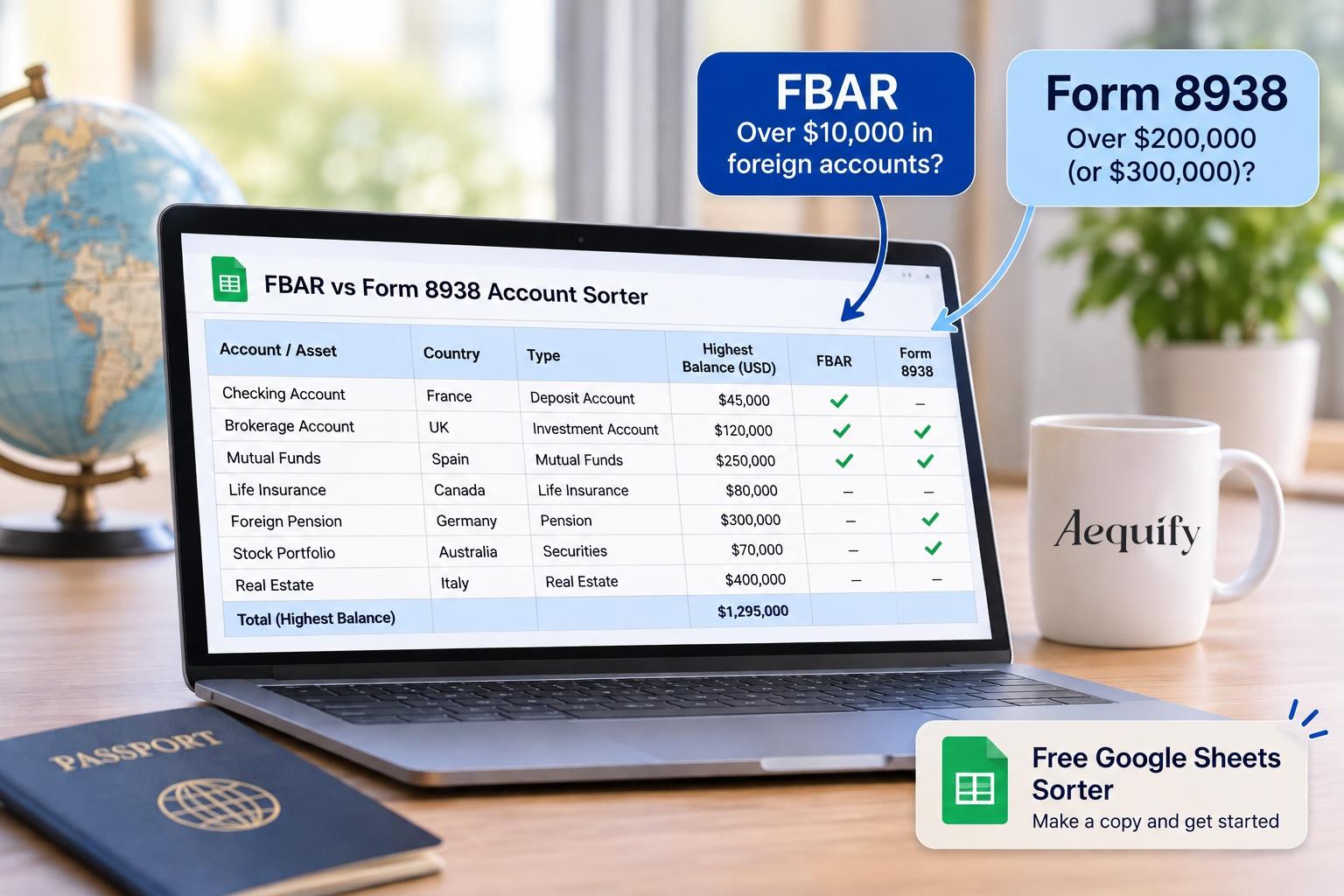
Every January, tax advisers with US clients abroad sort the same list: which accounts go on the FBAR, which go on Form 8938, and which go on both. The IRS publishes a comparison chart that answers it account by account. We turned that chart into a free sheet you can send to each client.
Get the free sorter: make your own copy in Google Sheets
One row per account or asset, with institution, country, type, highest balance and year-end balance. The sheet marks each row for Form 8938 and the FBAR and adds up both tests. Free, no sign-up. Make a copy in Google Sheets or download it for Excel.
Two forms, two tests
- FBAR (FinCEN 114): required when the combined value of foreign financial accounts is over $10,000 at any time in the calendar year. Filed with FinCEN, not with the tax return. Due April 15, with an automatic extension to October 15.
- Form 8938: filed with the income tax return. For a client living abroad, the threshold is over $200,000 on the last day of the year or over $300,000 at any time (single or married filing separately), and $400,000 or $600,000 for married filing jointly. For clients living in the US it is $50,000 or $75,000, and $100,000 or $150,000 for joint filers.
Form 8938 does not replace the FBAR, so many clients file both.
Which accounts go where
Most of the work is in the account types that land on one form but not the other. From the IRS chart:
- Both forms: deposit and custodial accounts at foreign financial institutions, foreign mutual funds, and foreign-issued life insurance or annuities with a cash value.
- FBAR only: an account at a foreign branch of a US financial institution, and accounts where the client has signature authority only (subject to exceptions).
- Form 8938 only: foreign stock or securities held outside a financial account, foreign partnership interests, and foreign hedge funds or private equity funds.
- Report the account, not the holdings: foreign stocks held inside a foreign brokerage account are covered by reporting the account on both forms.
- Neither form: foreign real estate, currency, precious metals and personal property held directly, and US mutual funds that invest abroad.
The sheet lists all 19 rows of the IRS chart, plus a row for assets the chart does not list, such as many foreign pensions, which it marks for the tax adviser to decide.
How to use it with clients
- Make one copy per client household and delete the example rows.
- Ask the client to add each account or asset outside the US, with its highest balance and year-end balance in US dollars.
- Set where the client lives and their filing status at the top. The sheet marks each row and shows whether the FBAR and Form 8938 tests are likely met.
- Review the list, confirm exchange rates and ownership, and decide what is filed.
The totals add each asset's highest value, which is a simplification. Treat the sheet as a first sort, not the final answer.
Skip the typing with connected accounts
The slow part is getting the list from the client in the first place. Clients on Aequify connect their accounts across countries in one place, and you receive a tax-ready data pack for the return instead of balances typed by hand.
Advising clients in this situation? See how Aequify works for advice firms.
This article provides general information for tax and financial advisers and is not tax or legal advice. Source: IRS, Comparison of Form 8938 and FBAR Requirements (checked 3 November 2026). The IRS notes the chart is current only to its publication date; check the current form instructions.