Personal FinanceGlobal Mobility
Why U.S. Brokerage Accounts Get Restricted When You Move Abroad
U.S. brokers may restrict or close investment accounts when Americans move abroad. Learn how Vanguard, Fidelity, Schwab and other firms treat expatriate clients, plus the tax and transfer steps to consider.
 Aequify TeamEditorial @ Aequify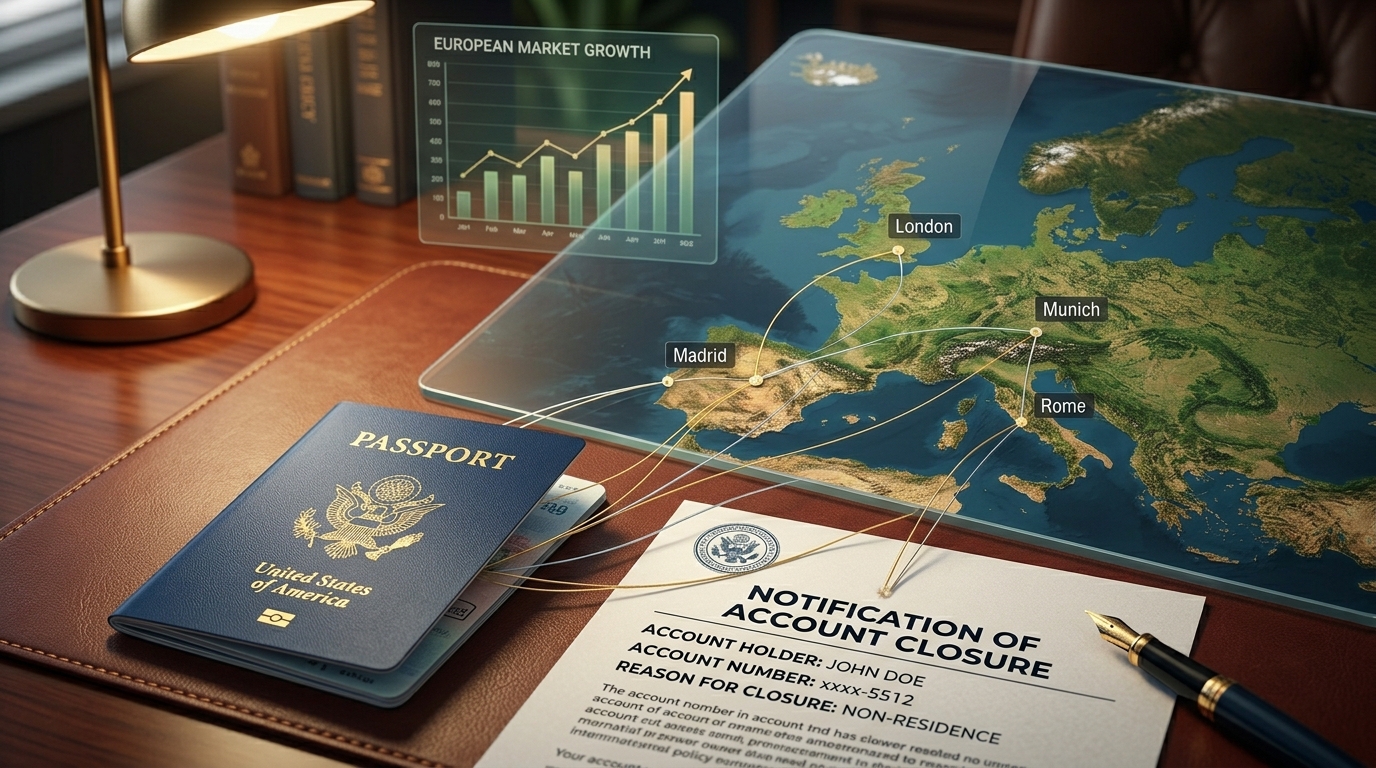
Move abroad and your US brokerage account can stop working the way it did at home. Your broker may block fund purchases, refuse deposits, end advice or ask you to move the account.
No federal rule forces this. Each firm sets its own policy by country, account type and service channel.
Investing from a US taxable brokerage account as an expat: 2026 considerations
Keeping the account open is step one. What you hold and how you report it is where the cost hides:
- Avoid non-US funds. A foreign mutual fund or ETF is usually a PFIC, with punitive tax and a Form 8621. US-domiciled ETFs avoid that.
- Plan for two tax authorities. Once you live abroad, dividends and gains are usually taxable in both countries. Treaty relief and the foreign tax credit decide which one you pay.
- Track currency per trade. The IRS measures every trade in dollars and your new country in local currency, so one trade can be a gain in one and a loss in the other.
- Know the thresholds. A US account is not reportable on FBAR, but foreign replacements are, above $10,000 combined. Form 8938 starts at $200,000 for a single filer abroad.
- Check product limits, not just access. Some custodians keep the account open but block mutual funds or options for foreign addresses.
Full detail on each point: US expat taxable brokerage accounts: 2026 investment considerations.
Why brokers restrict accounts held by Americans abroad
Local investment laws and compliance cost. A US fund registered at home may not be authorized for retail sale in Spain or Germany, so brokers block new purchases rather than register. Foreign addresses also mean extra identity, sanctions and source-of-funds checks, which can cost more than a small client base earns.
FATCA is part of the backdrop, but it does not require US brokers to close these accounts.
European and UK disclosure rules. In the EU and EEA, the PRIIPs Regulation generally requires a Key Information Document before a retail sale. Most US ETFs have no EU-compliant KID, so brokers block them.
The UK began replacing PRIIPs with Consumer Composite Investment rules on April 6, 2026, fully effective June 8, 2027. Until then, access to US funds can still be limited. Moving to the UK? See US-UK taxes for American expats.
What the major firms do
Vanguard. Accounts that could not move off the legacy fund platform became Mutual Fund Direct accounts. Since April 17, 2026 they accept no new purchases, exchanges, incoming transfers, recurring purchases or direct deposits. You can still redeem or transfer out. This applies to those accounts, not every Vanguard customer abroad.
Fidelity. Its trading FAQ says it does not open accounts for new customers living abroad. Existing customers who move lose discretionary management and planning advice, cannot buy mutual funds or fund 529s or HSAs, and in some countries can only sell and withdraw. Existing self-directed funds can generally stay, with reinvestment allowed. Crypto accounts must be closed. Full detail: Fidelity account restrictions for US expats.
Wells Fargo Advisors. In January 2021 it stopped opening international wealth management accounts and began winding down existing ones, while continuing to serve active duty military and US government employees abroad. That was a wealth management exit, not a rule for every Wells Fargo product.
Morgan Stanley. In 2018 it gave some international clients 30 days to transfer or liquidate. It still serves some international clients but publishes no simple policy.
Merrill and other wealth firms. Advisers report restrictions for some Merrill clients abroad. Merrill, UBS, Ameriprise, Edward Jones, USAA and TIAA publish no simple country-by-country policy. Get your firm's answer in writing: will it keep the account, accept deposits, allow new investments and keep advising you?
Policies change without notice, and the letter usually arrives after the change. Aequify connects accounts across more than 30 countries into one view, so a restriction or a new filing threshold shows up in your dashboard, not your mailbox. Create a free account and connect your first institution.
Brokers that may work for Americans abroad
Charles Schwab International. Schwab offers brokerage accounts to eligible expatriates through its international account process: ID, proof of residence, and an SSN or tax ID where applicable. Eligibility and products vary by country.
Interactive Brokers. IBKR accepts residents of a long list of countries, but local rules still apply: an EU retail investor may not be able to buy a US ETF without a KID. Which IBKR entity holds your account, and your investor protection, can depend on where you live, so check IBKR's entity disclosures. Whether the account is FBAR or Form 8938 reportable depends on where it is maintained, not the brand.
Cross-border advisers. Some specialize in Americans abroad. Confirm where assets are held, whether the custodian accepts your country, what you can buy and what it costs.
The tax risk of using a local broker
A local account can fix custody and create a US tax problem. Many foreign funds and ETFs, including many European UCITS funds, may be Passive Foreign Investment Companies. Under the default rules, gains and some distributions face extra tax and interest, and a separate Form 8621 is generally due for each one.
Individual foreign stocks and bonds are not automatically PFICs, though a company can still qualify. Have a tax professional check any foreign fund before you buy. Already own one? Read our PFIC guide.
Aequify flags holdings that may be PFICs across your connected accounts, so your tax adviser starts from a list, not a guess. See what your own accounts look like.
What to do before moving
- Ask your broker in writing whether it will keep your exact account type and which deposits, investments and services will be restricted. One Aequify customer who retired to Spain updated their address and got a letter: they could hold and sell, but no longer add money or buy certain funds. Check before you move, not after.
- Research Schwab International and IBKR early. Check eligibility and prepare documents. Apply only when you can give accurate residence information.
- Download your records. Statements, tax forms, cost basis, purchase dates, beneficiaries. Cost basis does not always transfer cleanly.
- Do not sell just because purchases may be blocked. A taxable sale can create a capital gain. Weigh the tax against holding something you cannot add to.
- Check your new country's rules. The timing of a sale can decide which country taxes it and whether treaty relief applies.
What to do after receiving a closure letter
- Find the receiving firm first. Confirm it can open the right account, accept every holding and finish before the deadline.
- Ask for an in-kind transfer. Moving investments without selling generally does not realize a US gain. Check your residence country too. Most transfers use ACATS, but FINRA notes some assets, like proprietary funds, may not transfer.
- Protect retirement accounts. A trustee-to-trustee IRA transfer is generally not a distribution; see the IRS rollover guidance. If the money is paid to you, it may be taxable, plus a 10% additional tax under age 59½ unless an exception applies.
- Do not hide your residence. A relative's address does not change where you live, and inaccurate information can breach your agreement.
- Review your reporting. An account held outside the US generally counts toward the $10,000 FBAR threshold. Form 8938 has higher, separate thresholds, and one does not satisfy the other. Current figures: 2026 U.S. expat tax guide.
Keep monitoring your accounts
Broker policies change. Review every account yearly and before each move, keep cost basis current, and know your backup broker before you need one.
Doing that by hand across six institutions in three countries is the task that slips until something breaks. Aequify does it continuously: accounts from 30+ countries in one view and one currency, combined highest balances lined up against the FBAR and Form 8938 thresholds, possible PFICs flagged, and a read-only view for your advisers.
Create a free Aequify account. Connecting your first institution takes a few minutes.
Aequify does not hold or move money and does not replace professional advice.
Frequently asked questions
Will Fidelity close my account if I move abroad?
Not necessarily. Self-directed accounts can stay with restrictions. Managed relationships end, and in some countries you can only sell and withdraw.
Can Americans living in Europe buy U.S. ETFs?
Sometimes, but EU retail investors are commonly blocked from US ETFs without a KID. The UK has its own framework.
Does FATCA force brokers to close expatriate accounts?
No. Restrictions come from foreign investment laws, product rules, compliance cost and business decisions.
Can I transfer my brokerage account without selling?
Often, yes. Eligible holdings usually move in kind if the receiving broker accepts each one.
Can I open a U.S. brokerage account if I live outside the United States?
Usually not at mainstream US brokers, which require a US residential address, even for US citizens. A few run international arms for specific countries, so it depends on where you live.
What online brokers have country-based restrictions?
Effectively all of them. The pattern: no new accounts for non-residents, blocked US mutual fund purchases after you move, and sometimes hold-and-sell only. Your country matters more than your broker.
Does Schwab block access to brokerage accounts from abroad?
Logging in from abroad is not the problem; your country of residence is. Schwab ties what an account can do to your address of record, so a move can restrict some products.
What do international investors need to know before opening a U.S. brokerage account?
Three things. Documentation: non-US persons certify status on Form W-8BEN. Estate tax: US-situs assets above $60,000 can create US estate tax exposure for nonresident aliens. Product limits: US mutual funds are usually unavailable, and EU and UK residents face rules that block most US ETFs at retail.
Are there restrictions on options trading for international investors using a U.S. brokerage?
Often, yes. Firms commonly limit options approval for foreign addresses. Confirm yours survives an address change before you move.
How do brokers map jurisdictions to client accounts?
Through your address of record, W-8 or W-9 tax declarations, ID documents and sometimes login patterns. Mismatches get investigated, and a discovered one is the fastest route to a frozen account.
Is a brokerage account a U.S.-only concept?
No. Brokerage accounts exist in every developed market. What is American is the regulatory perimeter that makes serving non-residents costly, which is why these restrictions keep happening.
Quick answers by custodian and country
Fidelity or Vanguard: which works better from abroad?
Neither is built for it. Fidelity opens no new accounts for non-US addresses, ends managed accounts, blocks fund purchases and 529 and HSA contributions, and in some countries allows only selling. Vanguard's affected accounts have accepted no new purchases, exchanges or incoming transfers since April 17, 2026. Compare the restriction that hits you, not the brand.
How does Charles Schwab compare to Fidelity for investors living outside the US?
Schwab has an international account route for eligible expatriates, with ID, proof of residence and an SSN or tax ID. Fidelity has no equivalent for new customers abroad. Schwab's eligibility and products still vary by country.
Can international investors access the full range of U.S. investment products through a U.S. broker?
No. Your broker decides what it offers your country, and local rules decide what you can buy. In the EU and EEA, most US ETFs lack the required KID and are blocked at retail. The UK is moving to its own Consumer Composite Investment rules.
I am moving to a country in the EU or EEA. What changes?
Your US broker may keep the account open while local rules stop you buying US funds in it. Switching to local funds swaps one problem for another: many European UCITS funds may be PFICs, with extra US tax and interest charges.
What about Singapore, Hong Kong, Qatar, Oman or another hub outside Europe?
Same pattern, different details. Mainstream US brokers want a US address for new accounts, existing ones can be restricted by country, and some countries are sell-and-withdraw only. IBKR accepts a long country list and Schwab's route is country dependent. Get your country confirmed in writing.
What about Panama, Mexico, Jamaica, Honduras or elsewhere in Latin America?
Same answer. Get written confirmation that the firm will keep the account, accept deposits, allow new purchases and keep advising you, and confirm the receiving firm can take every holding before you move anything.
I am moving to India. Can I keep my U.S. brokerage account?
It is a country question, not an India question. No federal rule forces a closure; each firm decides by country, account type and channel. Get your broker's answer in writing before you go.
I used to live in the United States. Can I keep the account on a relative's address?
No. A relative's address does not change where you live, and inaccurate information puts the account at risk. Report your real address and work from there.
This article provides general information and is not tax, legal or investment advice. Policies vary by country, institution, account type and individual circumstances. Confirm current rules with your institution and qualified advisers before acting.