U.K. Tax
Moving to the UK as a US Expat? The New 2025 Tax Rules, Explained

Puneet Gupta
5 mins


Table of Contents
About Aequify
Stay Informed
Why Aequify Earned SOC 2 Type II | Secure Expat Financial Platform
Moving to the UK as a US Expat? The New 2025 Tax Rules, Explained
If you're a US citizen living in the UK, planning to move there, or thinking about leaving, one thing you need to know: the UK tax system changed significantly on 6th April 2025.
The old "non-dom" rules are gone. A new residence-based system has replaced them.
This matters more for Americans because you already deal with two tax systems. The US taxes you on your worldwide income wherever you live. The UK now taxes residents on their worldwide income too.
This guide explains what changed, who it affects, and what to do about it.
What changed on 6 April 2025?
Before April 2025, some people living in the UK could choose to pay UK tax only on foreign money they actually brought into the UK. This was called the remittance basis, and it was tied to the concept of domicile.
That option is now gone for new income and gains.
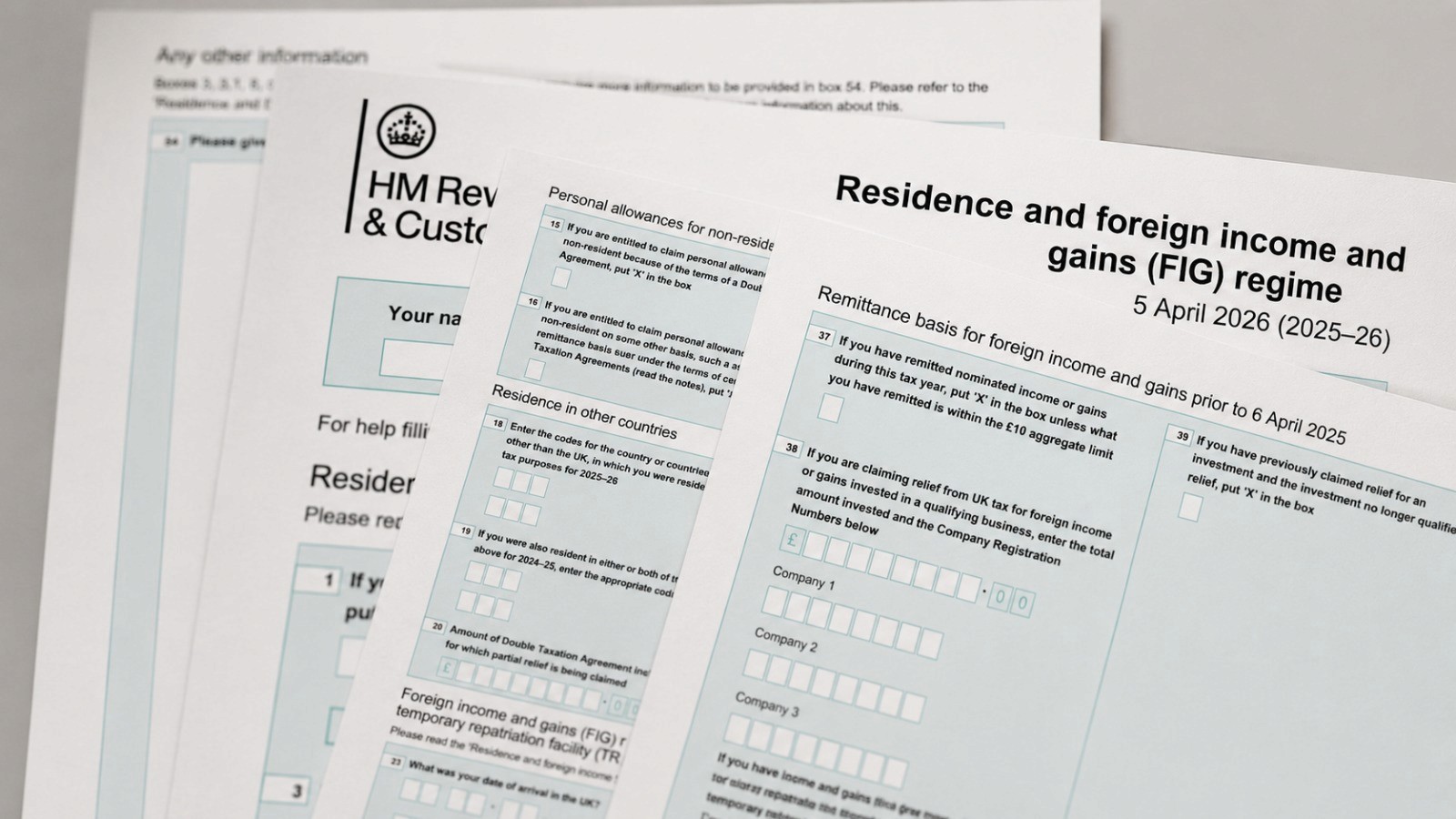
If you're UK tax resident today, you're taxed on your worldwide income and gains as they arise, unless you qualify for and claim the new Foreign Income and Gains regime, known as FIG.
Here's a quick summary of what shifted:
Before 6 April 2025 | From 6 April 2025 | |
|---|---|---|
What drives your UK tax | Domicile | Residence |
Foreign income | Taxed only if brought to the UK (for non-doms) | Taxed worldwide, unless FIG applies |
Relief for new arrivals | Remittance basis | 4-year FIG regime |
Inheritance tax | Based on domicile | Based on long-term residence |
First: the US still taxes you everywhere
Before anything else, a reminder that often gets overlooked.
As a US citizen, the IRS taxes your worldwide income no matter where you live. Living in London doesn't change that. So an American in the UK may need to report UK salary, US investments, UK bank interest, rental income, capital gains, pensions, and foreign accounts, to both countries.
The goal isn't to escape one country's tax. It's to avoid being taxed twice on the same money. Foreign tax credits and the US-UK tax treaty usually mean you pay roughly the higher of the two countries' rates, not both stacked on top of each other.
But this only works if you report correctly in both places. Which is why US expats need to think about both systems at once, not one at a time.
The 4-year FIG regime explained
FIG stands for Foreign Income and Gains. It's the UK's main relief for people who've recently moved here.
If you qualify, you pay no UK tax on eligible foreign income and gains for your first four years of UK tax residence, even if you bring the money into the UK.
The key condition: you must have been non-UK resident for the 10 consecutive tax years before you arrived. Miss that by even a year and you can't use FIG at all.
This is genuinely valuable if you're arriving with US investments, US rental income, or non-UK business income. But it isn't automatic. You claim it on your UK Self Assessment tax return, and you choose which income and gains to shelter.
What most people miss: the moment you make any FIG claim, even on a small foreign gain, you give up your UK personal allowance (£12,570) and your capital gains annual exemption (£3,000) for that entire year.
So FIG isn't always worth it. If your foreign income is modest, the lost allowances can cost more than the relief saves. Always model it before claiming.
Do you qualify?
Situation | Likely position |
|---|---|
Moving to the UK for the first time after 10+ years abroad | Probably qualify |
US expat who was UK resident in recent years | Probably don't qualify |
Arriving with US dividends, gains, or rental income | FIG could be very valuable |
Mainly UK salary, little foreign income | FIG may not be worth the lost allowances |
What about employment income?
FIG generally doesn't cover foreign employment income. If you move to the UK for work but spend some of your working days abroad, you look at Overseas Workday Relief (OWR) instead.
Three things changed on 6 April 2025:
1. OWR is now tied to FIG. You can only claim it if you qualify for FIG, the same 10-year non-residence test applies. No FIG eligibility means no OWR.
2. The window extended to 4 years (previously 3), aligned with the FIG period.
3. A cap now applies. Relief is limited to the lower of 30% of your qualifying employment income or £300,000 per tax year. This is the single biggest practical change and the one most commonly overlooked.
For Americans whose salary is taxed on both sides of the Atlantic, your payroll structure, employment contract, treaty position, and foreign tax credits all affect the final number. Don't assume the old OWR rules still apply.
Inheritance tax: the long game
This is the change with the longest shadow, and the one that tends to catch people off guard.
The UK replaced domicile with a residence test for inheritance tax.
You become a "long-term UK resident" once you've been UK tax resident for 10 of the previous 20 tax years. At that point, your worldwide estate, US brokerage accounts, US property, foreign bank accounts, and business interests can fall within the UK's 40% inheritance tax net.
If you're coming to the UK for two or three years, this probably won't affect you. If you're settling for a decade or more, it will.
And leaving doesn't switch it off immediately. Once you're a long-term resident, a "tail" keeps your worldwide assets exposed for 3 to 10 years after you leave, the longer you were resident, the longer the tail. The clock only resets after 10 consecutive years of non-residence.
If you're building wealth across both countries, don't leave inheritance tax planning until late in life.
Already in the UK before April 2025?
If you were already UK resident and used the remittance basis, you may have access to the Temporary Repatriation Facility (TRF).
The TRF lets former remittance-basis users bring pre-April 2025 foreign income and gains into the UK at a reduced flat rate: 12% in 2025/26 and 2026/27, rising to 15% in 2027/28. Compare that to normal rates of up to 45% on income.
One important wrinkle for Americans: the UK gives no credit for US tax you've already paid on those same funds. That can create a double-tax mismatch. It's worth modelling carefully with an adviser before you act.
Three real-world examples
Sarah, US executive moving to London
UK employment contract, US brokerage accounts, RSUs, regular overseas business travel. Her key questions: Does she qualify for FIG on her US investments? Can OWR shelter her non-UK workdays within the new cap? How are her RSUs split between countries?
Her biggest risk: assuming her employer's payroll handles all of it. It won't.
John, US retiree settling in the UK
Social Security, IRA income, US property, a brokerage account. His key questions: What does the US-UK treaty say about his pensions? Does FIG apply? Will his US assets eventually hit UK inheritance tax if he stays long term?
His biggest risk: focusing only on annual income tax and ignoring the slow build toward long-term residence.
Priya, US founder relocating to the UK
US company shares, stock options, crypto, clients across multiple countries. Her key questions: Should her shares be valued before she moves? Does she become UK resident? Will future gains be taxed in the UK?
Her biggest risk: moving first and planning later.
Why day counting matters more than ever
UK tax residence isn't about where you feel you live. It's decided by the Statutory Residence Test, which looks hard at how many days you spend in the UK, along with your home, work pattern, and family ties.
Your day count quietly controls almost everything covered in this article: whether you're UK resident at all, whether you qualify for FIG and OWR, and when you tip into long-term residence for inheritance tax.
A small error in counting can change your entire tax position.
Track it from day one. For every trip, record your arrival and departure dates, whether you spent midnight in the UK, and whether you worked that day. Keep the evidence, boarding passes, hotel bookings, calendar entries. Tag UK workdays separately from non-UK ones. And review your count during the year, not just at year-end.
How is Aequify helping expats and their advisors
Aequify is building a UK residence day tracker and evidence log for US expats and their advisers, so your day count, workday records, and travel evidence stay organised all year, not just at filing time.
Try Aequify for Free
Five mistakes to avoid
1. "I pay US tax, so UK tax doesn't apply to me." If you're UK resident, the UK taxes you too. The two systems overlap.
2. Not tracking days from the start. Your residence status, FIG eligibility, and OWR all hinge on the day count. Start recording on arrival.
3. Mixing money in messy accounts. Blending old savings, gains, and salary makes it hard to explain where funds came from, especially relevant if you ever use the TRF.
4. Assuming FIG is automatic or always worth claiming. You must actively claim it, and it costs you your UK allowances. Always check the maths first.
5. Forgetting US state tax. Some states continue to tax you after you move abroad. Check your exit position before you leave the US.
And don't forget the US information forms: FBAR, Form 8938, Form 1116 for foreign tax credits, and Form 8621 if you hold PFIC investments. The penalties for missing these can be severe.
Frequently asked questions
Do US citizens in the UK pay tax twice?
Often both countries want a return, but the US-UK tax treaty and foreign tax credits are designed to prevent true double taxation. Done correctly, you typically pay roughly the higher of the two rates, not both in full.
Does the FIG regime apply automatically?
No. You claim it through your UK Self Assessment tax return, and only if you meet the 10-year non-residence test.
Does FIG cover employment income?
Generally no. Employment income linked to overseas workdays may qualify for Overseas Workday Relief instead, subject to its own conditions and cap.
Will the new UK inheritance tax rules affect my US assets?
They can, once you become a long-term UK resident, that's 10 of the previous 20 UK tax years.
Do I really need to track my UK days?
Yes. Your residence status, FIG eligibility, OWR, and long-term inheritance tax exposure all depend on it.
Can Aequify help me manage the new UK tax rules?
Yes. Aequify connects your US and UK financial accounts, organises your documents, and prepares a clean data pack your adviser can work from directly. With just few clicks you can get the data for FBAR, Form 8938, foreign tax credits, and your UK filing obligations in one place.
Does Aequify track my UK residence days?
A UK residence day tracker is coming soon. It will record every day you spend in the UK with supporting evidence attached, monitor where you stand against the Statutory Residence Test, and flag your position against the FIG eligibility test and the long-term residence threshold for inheritance tax, all in real time.
The bottom line
The UK moved from a domicile system to a residence one. For Americans, who can never turn off US tax obligations, that creates a genuine two-country puzzle.
The 4-year FIG regime is a real opportunity for new arrivals, but not everyone qualifies, and claiming it isn't always the smart move once you factor in the lost allowances. Overseas Workday Relief has a new cap. Inheritance tax has a long reach if you stay.
The people who come out ahead are the ones who plan before they arrive, not after.
Track your days. Keep clean records. Understand your filing obligations in both countries. Think about FIG, OWR, and inheritance tax before you move. And work with an adviser who knows both sides of the Atlantic.
This article is general information only, not tax or legal advice. UK and US tax rules are complex and depend on your personal circumstances. Always speak with a qualified US-UK tax adviser before acting.

Ready to take control of your Global Finances?
Aequify provides you the tools to manage your finances no matter where you go.
Try for free
Aequify helps expats and globally mobile individuals manage cross-border finances by connecting bank and investment accounts, organizing transactions, and generating tax-ready reports for international tax filing workflows.
This includes support for common U.S. expat reporting needs like FBAR and FATCA (Form 8938) summaries, plus year-round visibility into income, expenses, and foreign accounts across countries. Aequify is a software platform only and does not provide tax, legal, or financial advice, and it does not guarantee compliance or results.
The Aequify Marketplace lists independent tax advisors and financial professionals who may specialize in U.S. expat tax, cross-border tax planning, and international filings. These advisors are not employees, agents, or representatives of Aequify. Aequify does not endorse, certify, or guarantee any advisor’s advice, work, fees, or outcomes. If you choose to work with an advisor, you engage and contract with them directly, and you should verify their credentials and fit for your situation.
If you have any questions, please contact us using the Contact Us form mentioned above.
Aequify helps expats and globally mobile individuals manage cross-border finances by connecting bank and investment accounts, organizing transactions, and generating tax-ready reports for international tax filing workflows.
This includes support for common U.S. expat reporting needs like FBAR and FATCA (Form 8938) summaries, plus year-round visibility into income, expenses, and foreign accounts across countries. Aequify is a software platform only and does not provide tax, legal, or financial advice, and it does not guarantee compliance or results.
The Aequify Marketplace lists independent tax advisors and financial professionals who may specialize in U.S. expat tax, cross-border tax planning, and international filings. These advisors are not employees, agents, or representatives of Aequify. Aequify does not endorse, certify, or guarantee any advisor’s advice, work, fees, or outcomes. If you choose to work with an advisor, you engage and contract with them directly, and you should verify their credentials and fit for your situation.
If you have any questions, please contact us using the Contact Us form mentioned above.
Moving to the UK as a US Expat? The New 2025 Tax Rules, Explained
If you're a US citizen living in the UK, planning to move there, or thinking about leaving, one thing you need to know: the UK tax system changed significantly on 6th April 2025.
The old "non-dom" rules are gone. A new residence-based system has replaced them.
This matters more for Americans because you already deal with two tax systems. The US taxes you on your worldwide income wherever you live. The UK now taxes residents on their worldwide income too.
This guide explains what changed, who it affects, and what to do about it.
What changed on 6 April 2025?
Before April 2025, some people living in the UK could choose to pay UK tax only on foreign money they actually brought into the UK. This was called the remittance basis, and it was tied to the concept of domicile.
That option is now gone for new income and gains.
If you're UK tax resident today, you're taxed on your worldwide income and gains as they arise, unless you qualify for and claim the new Foreign Income and Gains regime, known as FIG.
Here's a quick summary of what shifted:
Before 6 April 2025 | From 6 April 2025 | |
|---|---|---|
What drives your UK tax | Domicile | Residence |
Foreign income | Taxed only if brought to the UK (for non-doms) | Taxed worldwide, unless FIG applies |
Relief for new arrivals | Remittance basis | 4-year FIG regime |
Inheritance tax | Based on domicile | Based on long-term residence |
First: the US still taxes you everywhere
Before anything else, a reminder that often gets overlooked.
As a US citizen, the IRS taxes your worldwide income no matter where you live. Living in London doesn't change that. So an American in the UK may need to report UK salary, US investments, UK bank interest, rental income, capital gains, pensions, and foreign accounts, to both countries.
The goal isn't to escape one country's tax. It's to avoid being taxed twice on the same money. Foreign tax credits and the US-UK tax treaty usually mean you pay roughly the higher of the two countries' rates, not both stacked on top of each other.
But this only works if you report correctly in both places. Which is why US expats need to think about both systems at once, not one at a time.
The 4-year FIG regime explained
FIG stands for Foreign Income and Gains. It's the UK's main relief for people who've recently moved here.
If you qualify, you pay no UK tax on eligible foreign income and gains for your first four years of UK tax residence, even if you bring the money into the UK.
The key condition: you must have been non-UK resident for the 10 consecutive tax years before you arrived. Miss that by even a year and you can't use FIG at all.
This is genuinely valuable if you're arriving with US investments, US rental income, or non-UK business income. But it isn't automatic. You claim it on your UK Self Assessment tax return, and you choose which income and gains to shelter.
What most people miss: the moment you make any FIG claim, even on a small foreign gain, you give up your UK personal allowance (£12,570) and your capital gains annual exemption (£3,000) for that entire year.
So FIG isn't always worth it. If your foreign income is modest, the lost allowances can cost more than the relief saves. Always model it before claiming.
Do you qualify?
Situation | Likely position |
|---|---|
Moving to the UK for the first time after 10+ years abroad | Probably qualify |
US expat who was UK resident in recent years | Probably don't qualify |
Arriving with US dividends, gains, or rental income | FIG could be very valuable |
Mainly UK salary, little foreign income | FIG may not be worth the lost allowances |
What about employment income?
FIG generally doesn't cover foreign employment income. If you move to the UK for work but spend some of your working days abroad, you look at Overseas Workday Relief (OWR) instead.
Three things changed on 6 April 2025:
1. OWR is now tied to FIG. You can only claim it if you qualify for FIG, the same 10-year non-residence test applies. No FIG eligibility means no OWR.
2. The window extended to 4 years (previously 3), aligned with the FIG period.
3. A cap now applies. Relief is limited to the lower of 30% of your qualifying employment income or £300,000 per tax year. This is the single biggest practical change and the one most commonly overlooked.
For Americans whose salary is taxed on both sides of the Atlantic, your payroll structure, employment contract, treaty position, and foreign tax credits all affect the final number. Don't assume the old OWR rules still apply.
Inheritance tax: the long game
This is the change with the longest shadow, and the one that tends to catch people off guard.
The UK replaced domicile with a residence test for inheritance tax.
You become a "long-term UK resident" once you've been UK tax resident for 10 of the previous 20 tax years. At that point, your worldwide estate, US brokerage accounts, US property, foreign bank accounts, and business interests can fall within the UK's 40% inheritance tax net.
If you're coming to the UK for two or three years, this probably won't affect you. If you're settling for a decade or more, it will.
And leaving doesn't switch it off immediately. Once you're a long-term resident, a "tail" keeps your worldwide assets exposed for 3 to 10 years after you leave, the longer you were resident, the longer the tail. The clock only resets after 10 consecutive years of non-residence.
If you're building wealth across both countries, don't leave inheritance tax planning until late in life.
Already in the UK before April 2025?
If you were already UK resident and used the remittance basis, you may have access to the Temporary Repatriation Facility (TRF).
The TRF lets former remittance-basis users bring pre-April 2025 foreign income and gains into the UK at a reduced flat rate: 12% in 2025/26 and 2026/27, rising to 15% in 2027/28. Compare that to normal rates of up to 45% on income.
One important wrinkle for Americans: the UK gives no credit for US tax you've already paid on those same funds. That can create a double-tax mismatch. It's worth modelling carefully with an adviser before you act.
Three real-world examples
Sarah, US executive moving to London
UK employment contract, US brokerage accounts, RSUs, regular overseas business travel. Her key questions: Does she qualify for FIG on her US investments? Can OWR shelter her non-UK workdays within the new cap? How are her RSUs split between countries?
Her biggest risk: assuming her employer's payroll handles all of it. It won't.
John, US retiree settling in the UK
Social Security, IRA income, US property, a brokerage account. His key questions: What does the US-UK treaty say about his pensions? Does FIG apply? Will his US assets eventually hit UK inheritance tax if he stays long term?
His biggest risk: focusing only on annual income tax and ignoring the slow build toward long-term residence.
Priya, US founder relocating to the UK
US company shares, stock options, crypto, clients across multiple countries. Her key questions: Should her shares be valued before she moves? Does she become UK resident? Will future gains be taxed in the UK?
Her biggest risk: moving first and planning later.
Why day counting matters more than ever
UK tax residence isn't about where you feel you live. It's decided by the Statutory Residence Test, which looks hard at how many days you spend in the UK, along with your home, work pattern, and family ties.
Your day count quietly controls almost everything covered in this article: whether you're UK resident at all, whether you qualify for FIG and OWR, and when you tip into long-term residence for inheritance tax.
A small error in counting can change your entire tax position.
Track it from day one. For every trip, record your arrival and departure dates, whether you spent midnight in the UK, and whether you worked that day. Keep the evidence, boarding passes, hotel bookings, calendar entries. Tag UK workdays separately from non-UK ones. And review your count during the year, not just at year-end.
How is Aequify helping expats and their advisors
Aequify is building a UK residence day tracker and evidence log for US expats and their advisers, so your day count, workday records, and travel evidence stay organised all year, not just at filing time.
Try Aequify for Free
Five mistakes to avoid
1. "I pay US tax, so UK tax doesn't apply to me." If you're UK resident, the UK taxes you too. The two systems overlap.
2. Not tracking days from the start. Your residence status, FIG eligibility, and OWR all hinge on the day count. Start recording on arrival.
3. Mixing money in messy accounts. Blending old savings, gains, and salary makes it hard to explain where funds came from, especially relevant if you ever use the TRF.
4. Assuming FIG is automatic or always worth claiming. You must actively claim it, and it costs you your UK allowances. Always check the maths first.
5. Forgetting US state tax. Some states continue to tax you after you move abroad. Check your exit position before you leave the US.
And don't forget the US information forms: FBAR, Form 8938, Form 1116 for foreign tax credits, and Form 8621 if you hold PFIC investments. The penalties for missing these can be severe.
Frequently asked questions
Do US citizens in the UK pay tax twice?
Often both countries want a return, but the US-UK tax treaty and foreign tax credits are designed to prevent true double taxation. Done correctly, you typically pay roughly the higher of the two rates, not both in full.
Does the FIG regime apply automatically?
No. You claim it through your UK Self Assessment tax return, and only if you meet the 10-year non-residence test.
Does FIG cover employment income?
Generally no. Employment income linked to overseas workdays may qualify for Overseas Workday Relief instead, subject to its own conditions and cap.
Will the new UK inheritance tax rules affect my US assets?
They can, once you become a long-term UK resident, that's 10 of the previous 20 UK tax years.
Do I really need to track my UK days?
Yes. Your residence status, FIG eligibility, OWR, and long-term inheritance tax exposure all depend on it.
Can Aequify help me manage the new UK tax rules?
Yes. Aequify connects your US and UK financial accounts, organises your documents, and prepares a clean data pack your adviser can work from directly. With just few clicks you can get the data for FBAR, Form 8938, foreign tax credits, and your UK filing obligations in one place.
Does Aequify track my UK residence days?
A UK residence day tracker is coming soon. It will record every day you spend in the UK with supporting evidence attached, monitor where you stand against the Statutory Residence Test, and flag your position against the FIG eligibility test and the long-term residence threshold for inheritance tax, all in real time.
The bottom line
The UK moved from a domicile system to a residence one. For Americans, who can never turn off US tax obligations, that creates a genuine two-country puzzle.
The 4-year FIG regime is a real opportunity for new arrivals, but not everyone qualifies, and claiming it isn't always the smart move once you factor in the lost allowances. Overseas Workday Relief has a new cap. Inheritance tax has a long reach if you stay.
The people who come out ahead are the ones who plan before they arrive, not after.
Track your days. Keep clean records. Understand your filing obligations in both countries. Think about FIG, OWR, and inheritance tax before you move. And work with an adviser who knows both sides of the Atlantic.
This article is general information only, not tax or legal advice. UK and US tax rules are complex and depend on your personal circumstances. Always speak with a qualified US-UK tax adviser before acting.

Aequify helps expats and globally mobile individuals manage cross-border finances by connecting bank and investment accounts, organizing transactions, and generating tax-ready reports for international tax filing workflows.
This includes support for common U.S. expat reporting needs like FBAR and FATCA (Form 8938) summaries, plus year-round visibility into income, expenses, and foreign accounts across countries. Aequify is a software platform only and does not provide tax, legal, or financial advice, and it does not guarantee compliance or results.
The Aequify Marketplace lists independent tax advisors and financial professionals who may specialize in U.S. expat tax, cross-border tax planning, and international filings. These advisors are not employees, agents, or representatives of Aequify. Aequify does not endorse, certify, or guarantee any advisor’s advice, work, fees, or outcomes. If you choose to work with an advisor, you engage and contract with them directly, and you should verify their credentials and fit for your situation.
If you have any questions, please contact us using the Contact Us form mentioned above.
Aequify helps expats and globally mobile individuals manage cross-border finances by connecting bank and investment accounts, organizing transactions, and generating tax-ready reports for international tax filing workflows.
This includes support for common U.S. expat reporting needs like FBAR and FATCA (Form 8938) summaries, plus year-round visibility into income, expenses, and foreign accounts across countries. Aequify is a software platform only and does not provide tax, legal, or financial advice, and it does not guarantee compliance or results.
The Aequify Marketplace lists independent tax advisors and financial professionals who may specialize in U.S. expat tax, cross-border tax planning, and international filings. These advisors are not employees, agents, or representatives of Aequify. Aequify does not endorse, certify, or guarantee any advisor’s advice, work, fees, or outcomes. If you choose to work with an advisor, you engage and contract with them directly, and you should verify their credentials and fit for your situation.
If you have any questions, please contact us using the Contact Us form mentioned above.